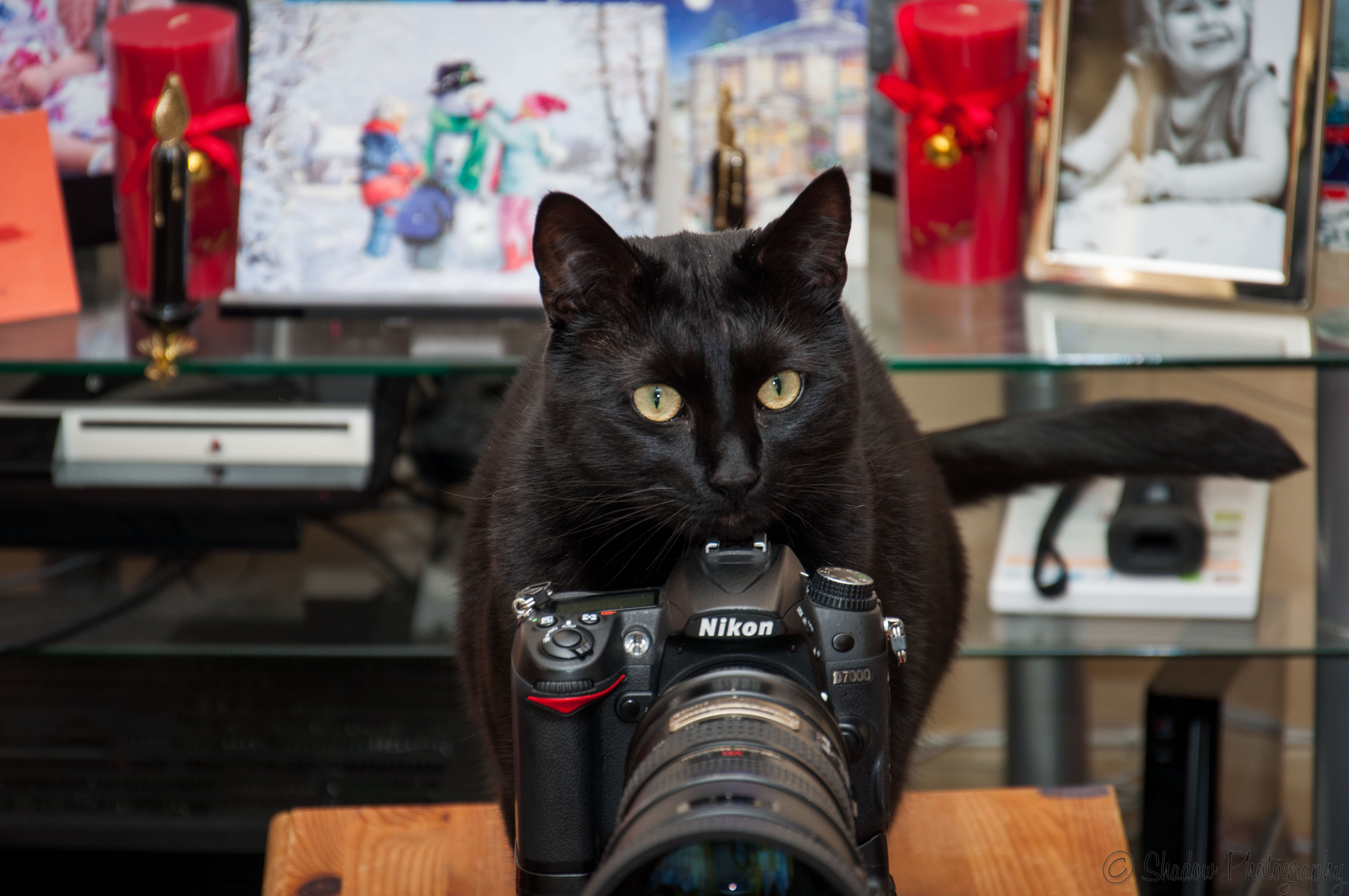
Shad contemplates his career

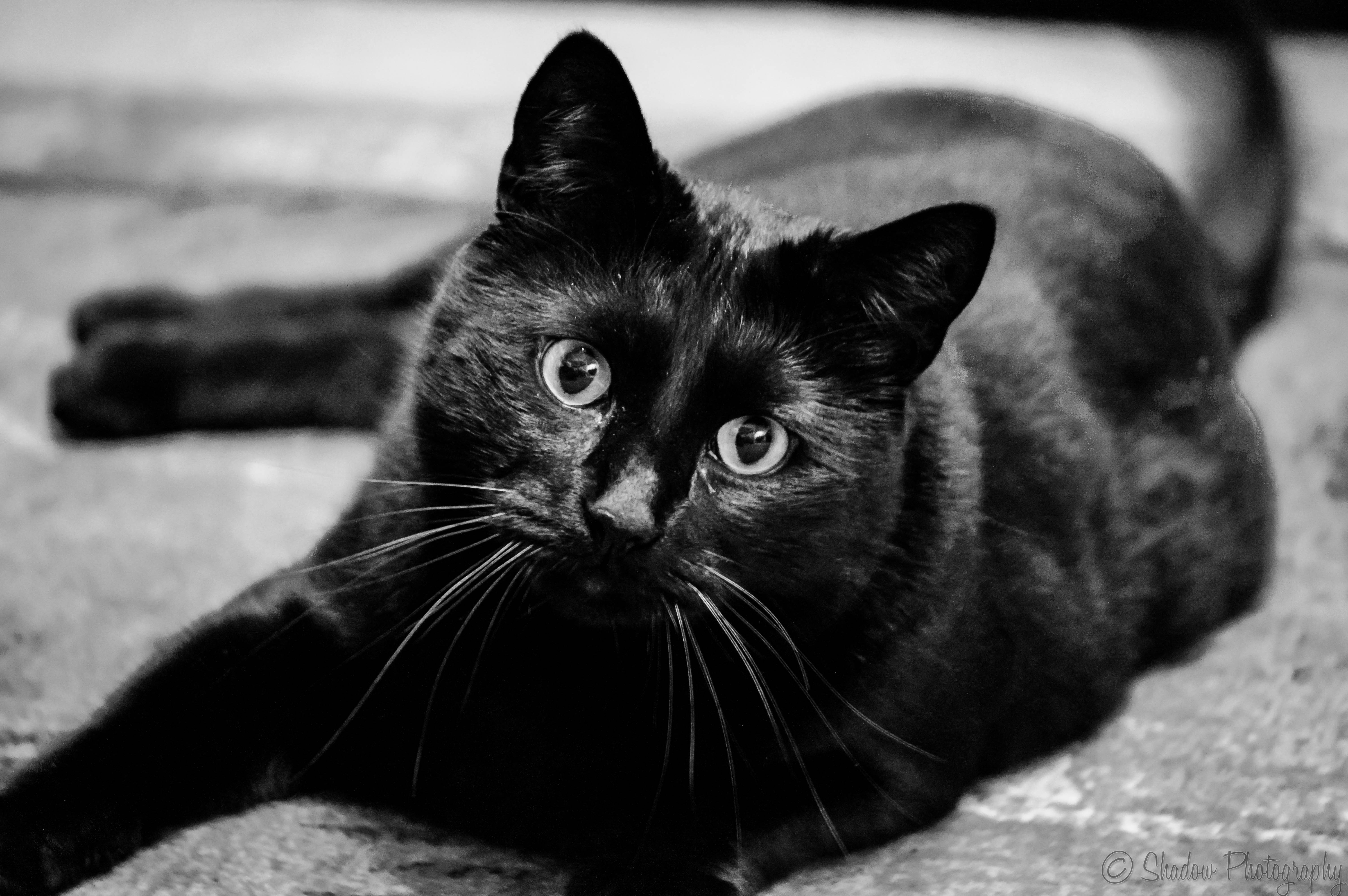
These pictures are of one of my pretty domestic feline cousins.  She absolutely insisted that I share it with you.  Vain, yes I think so!!  But she’s cute so she gets away with it.  Her name is Muffin and being a sleek black cat like me, she is a little tricky to capture on film.  The facial features and subtle colour changes of black cats (just like white cats) can be difficult to see on camera because there is no contrasting colour for the auto focus to lock onto.  With practice, such photography becomes easier and I was pleased with the pictures John and I took of Muffin that day.  So was she, as you can tell from the self-satisfied expression on that adorable little face!!

John and I have been amateur photographers for many years and decided to go professional in early 2013.  It’s been an exciting year given that I am passionate about camerawork and had the opportunity to shoot different people and animals in a wide range of places and contexts.  I’ve learned so much and seen an improvement in my work and I’ve gained a name for myself as a photographer who listens to his clients and creates images that leave a lasting impression.  We’ve also had so much fun and I think it’s important to laugh and enjoy your vocation and help people relax.  But it has also been the most challenging time.  There are so many photographers charging too much without delivering on their promises, or charging too little, reflecting their bargain-basement attitude.  It’s a competitive industry.

Making a success of the business sometimes feels like an arduous task and no matter how honourable and capable I am, there’s always someone out there waiting to get one over on you!  But John and I make a good team.  With John’s skilful use of the lens and his technical expertise, and my impeccable charm and eye for composition, we’re determined to rise to the challenge.  By the way, in case you’re curious, Muffin has a personality as endearing as her petite velvety nose, and we’re just good friends!
Shadow

Shad does the franco-english Marwell tour

Have you seen a ‘hippopotame pygmée’ or a ‘singe’ recently?  You would have, if you’d been with John and I at Marwell Wildlife Park this weekend.  Two of John’s friends were visiting from across the Channel and we decided to give them a guided tour of the wonders of the natural world at Marwell.  They came from Marseille which is the second largest city in France after Paris.  Marseille is an urban area with a large population and a rugged rocky coastal landscape, a far cry from the wooded hills and rolling countryside of Winchester where Marwell is situated.  There were 5 of us altogether, including 2 people who spoke both English and French and were able to translate, and one person who spoke French only.  John speaks a little German but that didn’t really help, and I speak cat which I consider a universal language, but that didn’t help much either!!

Have you worked out those French words yet?  The first one is pygmy hippopotamus, and we were lucky enough to get a clear view of a mother with her little female calf who was born on 13th December 2013.  The baby is part of the European Endangered Breeding Programme and is called Gloria, a name chosen by patrons of the zoo and members of the public following an online vote.  ‘Singe’ (pronounced ‘sairnge’) is French for monkey, and there was plenty of monkeying around as we watched the Colobus monkeys strike a pose for the camera and swing across the branches with their long arms and tails.

There was much guffawing at the giraffe area because these tall elegant creatures with big beautiful eyes looked so demure, but when they munched on their dinners, the prolonged chewing action combined with large elf-like ears made an amusing sight.  I held my tail high as a friendly greeting and made chirrup noises to communicate my appreciation of their awesomeness, but I’m small compared to them and I don’t think they saw me.

Unlike the big cats, which spotted me instantly, may be because they smelt me coming.  Not that I have some sort of body odour problem I hasten to add, but more due to the feline ability to convey identity and mood through scent.  Marwell has taken in a new male Amur tiger called Bagai who is 17 months old and is settling into his new environment before being introduced to Milla, a female Amur tiger.  It is hoped that they will produce offspring to help save this highly endangered species which is on the brink of extinction.  Shockingly, the evil poachers continue to trap and kill these magnificent beasts along with many other animals who now struggle to survive in their native environments.  My thanks go to the conservationists across the world and animal welfare groups such as PETA, IFAW and the WSPCA for their efforts in promoting the wellbeing of animals and giving them a voice.

2013 was a busy year for the keepers at Marwell who also welcomed a giant anteater baby born in November.  Little Rojo seemed content and was fully occupied when we saw him in his enclosure with his mum,  digging at a branch with his long fore-claws, looking for insects.  These curious looking creatures are listed as ‘vulnerable’ in the wild and have thick necks and a tubular snout which ends in a tiny mouth opening and nostrils.  They apparently have poor eyesight but a sense of smell 40 times more sensitive than that of humans.

John’s French friends were visibly impressed at how well the animals were cared for and how keen the Brits are to keep animals as happy and healthy as possible.  They went home with lots of photos and good memories from their trip to the zoo, and I improved my language skills and did my bit for anglo-french relations.  So au revoir, c’est la vie and bon voyage!

Shad sees the New Year in

Rookesbury Park is a former stately home situated at the end of a sweeping drive in the secluded Hampshire countryside.  This Grade II listed building with its majestic lawns was the location for a special New Years Eve shindig with the Saga Louts, a mellow crew of rock ‘n’ rollers who know how to swing the night away with their rock style.

John and I arrived at the venue around 7.30pm (way past my usual bed-time!) to find the band warming up.  I figured if I was going to be at home listening to the noisy bangs of fireworks, I may as well go out with John and listen to the loud booms of a live band and have some fun.  As the evening went on, I made friends with a great little doggy who was obviously used to being around cats.  I amused myself watching his ears flap around when he got excited.  The party-goers were in good spirits and the drums beat their rhythm with energy.  The guitars were jammin’ and John’s brother Colin on lead vocals was kickin’ it Rod Stewart style.  Do I sound like a hippy groupie?  I could well be their first and only cat fan!

Anyway, apart from the great music, the Saga Louts are also good at getting their audience to relax and participate, thanks to their natural ability to laugh and joke around, encouraging people to join in.  Their vintage classic covers resulted in spontaneous singing and dancing from the crowd and they knocked out 60 songs including Rolling Stones, Yard Birds, Eric Clapton, Chuck Berry and Black Sabbath.  I sat on one of the tables and got lots of attention, especially from the ladies who were cooing over me and giving me titbits of turkey from the buffet.  I could see Colin watching me, trying to copy my moves, but only Shad has the silky swagger Romeo!!

Shad gets Jiggy with the Saga Louts

Proud Cub in the Setting Sun

This is one of the Snow Leopard cubs born in the spring at Marwell Zoo. Myself and John have watched them grow this year from fur balls into beautiful cats

Shad shoots more waifs and strays

John and I were hanging out with our friend who fosters the homeless cats.  Regular readers might remember about the pen for waifs and strays in her back garden.  John’s daughter Natasha joined us in the pen and we took these photos.  Its not easy taking photos in the pen due to the limited space and not wanting to frighten the residents.  But just look how cute these moggies are.

The chunky black and white is a 2 year old boy called Bandit.  He had just been to the vets to have ‘the chop’ the day before.  (I’ve been there mate!!)  Anyway, he is a really vocal cat, and the veterinary nurse said he meowed and meowed so much they could hear him in the waiting room.  Then apparently he got into a punch up with the cat next to him, poking his paws through the gaps in the cage, trying to bop him on the noggin.  Anyway, enough gossiping!  He was surrendered by his owner because she had to move house and couldn’t take him.

The other two tiny creatures are Tickle (11 years old) and Whiskey (6 years old).  These friendly little ladies have lived most of their lives outside and were not being cared for by their owner who by all accounts preferred a drink than to spend time caring for the cats.  They told me how happy they were to be safe and warm and dry and fed and stroked every day.  Good luck to Whiskey and Tickle and Bandit and all the pussy cats looking for homes this Christmas.

Shad Talks Christmas Lights

As a cat, I’m generally attracted to pretty, sparkly and flashy things.  So it’s no surprise that the Christmas decorations adorning some of the houses in the area have caught my eye.  Just look at the colourful canopy and happy hues that light up the night sky.  Despite my excitement at the shimmering and twinkling kaleidoscope of colours, I can’t help but express concern about the increased use of energy as a result of excessive Christmas lighting.  It also leads to extensive recycling issues, with as much as 20 million pounds of discarded holiday lights being shipped to China every year for recycling.

But before you all start shouting ‘humbug’, I confess that they are bright and festive and mark a celebration of family and friendship, something to be treasured.  They are also being used to raise money for good causes.  Locally, one family is fund-raising for multiple sclerosis by asking for donations from onlookers.  But before you pay, please be sure that you trust those who are collecting, as I would hate for your hard-earned pennies to be misused by a dishonest person.

The pagans used evergreens and lights in their winter rituals and the custom must have been adopted by Christians who started to bring trees into their homes.  It is said that the Germans combined the elements of a tree and lights and the tradition of illuminating the tree with candles begun (in the 17th to 18th century).  Candles for the tree were glued with melted wax to a tree branch or attached by pins. If you thought stringing popcorn for hours could get tedious, imagine fumbling around trying to attach a multitude of lit candles to a tree using melted wax or pins. Revelers eager to keep their holiday spirits bright needed to keep a bucket of water or sand on standby!!  Despite the dangers of mixing open flame with drying-out trees, candles would remain a Christmas staple into the early 20th century, when candle-holders, small lanterns and glass balls were used to hold the candles.

Eventually electric Christmas lights were introduced and strings of electric lights found their way into use in places other than the Christmas tree.   By the mid-20th century, strings of fairy lights were being displayed on mantles and around doorways, across porches and roof lines and along streets.  Now they range from simple light strands to animated tableaux involving illuminated animatronics and statues, no doubt often fuelled by friendly neighbourhood rivalry as to who has the best display.  National grid on standby!!

If you decide to decorate your house this year, please be careful climbing up ladders and remember that repeatedly using the same extension cord is a safety hazard.  Don’t forget to think about your decorations from your pet’s point of view in order to us safe.  Try crawling around on the floor thinking about what you might like to chew if you were an animal!  If you start meowing or woofing, you might want to think about getting a check-up from the neck up!

Happy Christmas and a prosperous and healthy New Year to all Shad the Cat’s readers.  Thank you for your loyalty and continued support.

Shad does the New Forest Wildlife Park

John took me on a forest adventure this weekend to a wildlife park near Ashurst in Southampton.  It’s part of the New Forest, an ecologically rich area of grassland, heathland and woodland in the south-east of England which provides habitats for all kinds of rare and unusual plants, insects, birds and mammals.  The wildlife park is set deep in the forest and surrounded by tall trees that looked to me like giant fortresses topped with emerald-green and nut-brown foliage.  I could feel the eyes of the multitude of shy forest creatures that were hiding in the trees watching me as I trotted along next to John.

We followed the moss-veiled trails that led to some animals that I don’t often get the chance to photograph.  Like the big beefy bison that was lazily munching on some grass.  He appeared peaceful and unconcerned but I had no doubt that one insolent flick of my tail might cause him to lower his solid horned head and charge towards us.  I was pleased to see the lynx, with its short tail and tufts of black hair on its ear-tips, it had large paws and all the characteristics of a finely-tuned stealth survivor.  Then there were the gregarious and industrious giant otters, highly sociable animals who live in extended family groups.  They were most entertaining, sleeping happily together in huddles and playing noisily, barking, snorting and whistling at each other with enthusiasm.

All of these animals are highly endangered, struggling to adapt to habitat loss and fighting for their lives when they are hunted, the bison for their meat and skins, the otters for their velvety pelts and the lynx for their fluffy patterned fur coats.  Despite the humans that are willing to inflict suffering and even wipe out an entire species for the sake of fashion or status, there are many more humans willing to protect what nature has provided us and teach others to do the same.  The New Forest Wildlife Park actively promotes the conservation of animals through rescue work as well as participation in breeding programmes to protect the future of many endangered species, from our native orphaned and injured otters, owls and deer, to the European bison, the little harvest mouse and the rarely seen Scottish wildcat.

This natural forest environment was the perfect area for us to spot much local indigenous wildlife and, when I stopped to listen, I could hear the occasional drumming woodpecker or the scurrying of a squirrel crunching twigs and rustling leaves as it busied itself looking for its next meal.  Also looking for meals were the birds, like the bold robin who landed right in front of us hoping for a bit of John’s sandwich.  Don’t worry, regular readers know I like birds and I’m well in control of my hunting instincts, so the birds are safe with me (although John keeps an eye on me as a precaution)!

http://www.newforestwildlifepark.co.uk/

Shad does Tangmere Military Aviation Museum

Situated at the former Battle of Britain RAF airfield in West Sussex, the museum is home to a number of historic aircraft and exhibits and is a fitting tribute to those who flew and served from Tangmere during its active past.  Its purpose is to promote public awareness of the UK’s military aviation heritage and serve as a memorial to the air men and women who gave their lives in the service of this country.


I tried to imagine what it must have been like for the pilots of the Spitfires as they headed towards Dunkirk in the autumn of 1940.  Perhaps the growling sound of the Rolls-Royce engine and morale boosting government propaganda filled them with confidence for a cast-iron victory.  Perhaps this newly designed powerful fighter hid apprehension and fear at the thought of leaving their pals and kinfolk at home for situations unknown.  Sadly, we cats also faced the horror of war as many family pets were killed during those dark days due to misconceptions about what was the patriotic and humane thing to do.  The slaughter of animals was also apparently driven by a panic-fuelled government who even allowed one unfortunate woman to be fined £5 (the equivalent of around £230 in today’s money) for giving bread to her pet white mice.  This information is from a book called ‘Bonzo’s War: Animals Under Fire’ about the animal experience in World War II.


John is the military enthusiast, not me, so he took these pictures and can probably name each of the machines we saw.  I might not know what they’re called, but I know that each engine and instrument and technological advancement created in the development of military aviation was spurred by conflict that affected the lives of humans and animals in countless ways.   I count myself a lucky pussy-cat to be living in the safety and comfort of my home on the south coast of England, pondering the issues of the day and writing my musings in a blog, for smart and discerning readers like you to read and share.