Shad’s big adventure (part 4)

When you go into the woods next time, walk deep into the thicket then stand perfectly still and you might hear the sound of a bird chirping its daily news to a friend in another tree or the snap of a twig trodden on by a deer as it munches through leaves and acorns.  John and I have often wandered through the local woodlands which form part of the South Downs in Sussex and heard the birds sing and the rustle of the wind blowing through the trees.  Standing in the woods many hundreds of years ago we would have heard the grunts and tail slaps of a family of beavers, the barking howls of a pack of wolves or the hissing and chattering of a Eurasian lynx cat.  Sadly due to the intensification of agriculture and human hunting activities many the UK’s indigenous wild mammal populations such as wolves, brown bears, lynx and beavers are now extinct.  This is why I get so excited about the wildlife that still exists in the woods today like the badgers, foxes, otters, rabbits, wood lice, harvest mice, wagtails, buzzards and tawny owls who rely on each other in complex ways and need our protection to survive.
DSCF0389-Edit

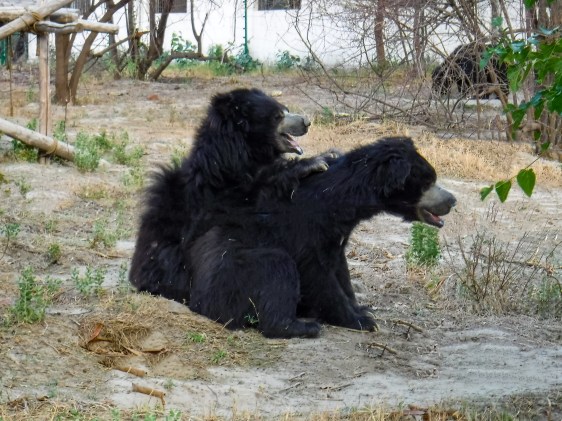
In India the forest surrounding the Agra Bear Rescue Facility managed by Wildlife SOS is alive with squawks, tweets, clicks, growls, wails, screeches and squeaks from the enormous variety of animals that live there.  Their bizarre noises reminded me of those made by tennis players during the Wimbledon finals!   The sloth bears that live at the centre have all been rescued from a nomadic tribe called the Kalandar people who traditionally used them as ‘dancing bears’ for hundreds of years.  This brutal practice involves poaching the cubs from the wild (usually killing the mother), piercing their soft sensitive muzzles with a hot poker and pushing a rope through it which is tugged in order to force them to jump up and down in pain for the entertainment of onlookers.  Hard to believe isn’t it?!

Life at the end of a rope was all these bears knew and many can be seen rocking, pacing and swaying, demonstrating stress behaviours seen in large mammals that have been taken captive and held in poor conditions.  The good news is that Wildlife SOS are doing an excellent job of providing veterinary care to heal their physical wounds and a stimulating natural environment to heal their emotional wounds, and they’ll never have to endure such cruelty again.  To help the bears, Wildlife SOS keepers have installed pools in every enclosure for splashing and general merriment and frames and trees for climbing.  There are also daily enrichment activities such as foraging for their favourite fruits in boxes or feeders and munching on a honey and ant bar.  Nice!

There is plenty of love to go around at Wildlife SOS and all orphaned, abandoned or injured animals are welcomed with open arms, just like the hyena that wandered innocently into a village looking for food and was attacked by the ignorant villagers or the baby deer who lost her mum in a forest fire.  The wild monkeys who live in the trees often steal leftover melons from the sloth bears that are too busy rolling around in the grass to notice, and a blind parakeet that obviously could not survive in the wild lives happily in the office and is taken outside daily for some fresh air.  Wildlife SOS is a sanctuary for many beautiful lives that would otherwise have been lost and their dedication to the environment goes some way towards undoing the damage done by humans who exploit and persecute animals in the name of entertainment, religion or profit.  You can help too by never paying to watch, ride or pet wild animals used in the tourist industry because if you saw the terrible events that occur behind the scenes you would be shocked to the core.

Shad shoots a hockey game

John likes to challenge his photography skills by shooting sports and as he’s the one with the car, the wallet and the opposable thumbs, I tend to follow willingly.  Don’t misunderstand me, I admire the commitment and stamina displayed by the athletes in competitions and I’m glad that they have a means of channelling life’s emotions and frustrations through the performance and community of their sport.  For those of us who lack the motivation or talent for such strenuous activities, dealing with life’s idiosyncrasies is often a more sedate affair.  There are many other options including reading, writing, puzzles, photography and singing.  I frequently sing along with John in the car when he cranks up the Michael Bublé although lately he’s been going through a classic rock phase and I’ve enjoyed the discordant and often thunderous sounds of AC/DC, Van Halen and Metallica.

Despite my affinity for peaceful or solitary pursuits, there are many other cats who engage in sport to varying degrees.  Tigers like to swim, bobcats like to climb and I’ve even seen videos of servals at the Big Cat Rescue Centre in Tampa, Florida unravelling toilet rolls like it was the most fun in the world.  I know I’m stretching the definition of sport just a tad here but if there were organised competitive grooming events I’d be a real contender!   When we domestic cats are kittens we form teams to practice our running and pouncing skills and as we get older, sporting activities generally revolve around stalking our housemates, jumping on anything that wiggles or catching small furry or feathered creatures.  Don’t judge us, it’s in our genes and unlike humans we don’t have a highly developed prefrontal cortex that moderates our ethical and social behaviour.

But back to human sports and these hockey players  not only have highly developed brains that help them make fast decisions on the pitch, they also have highly developed muscles that give them the strength to propel the hockey ball up to 75mph, that’s as fast as a cheetah.  Each team is made up of 11 players and these particular teams were competing in the Hockey Champions Trophy 2016 at the Queen Elizabeth Olympic Park.  The teams use several substitutes throughout the game to keep everyone fresh and energetic and they often wear protective equipment such as gum shields as I imagine a knock from one of those big sticks would sting a bit!  The ones I really admired were the brave goalkeepers who dealt with balls shooting at them, team members yelling at them and opposing players hurtling towards them with grimaces on their faces, hence the leg protectors, chest guard and helmet!

Shad’s big adventure (part 3)

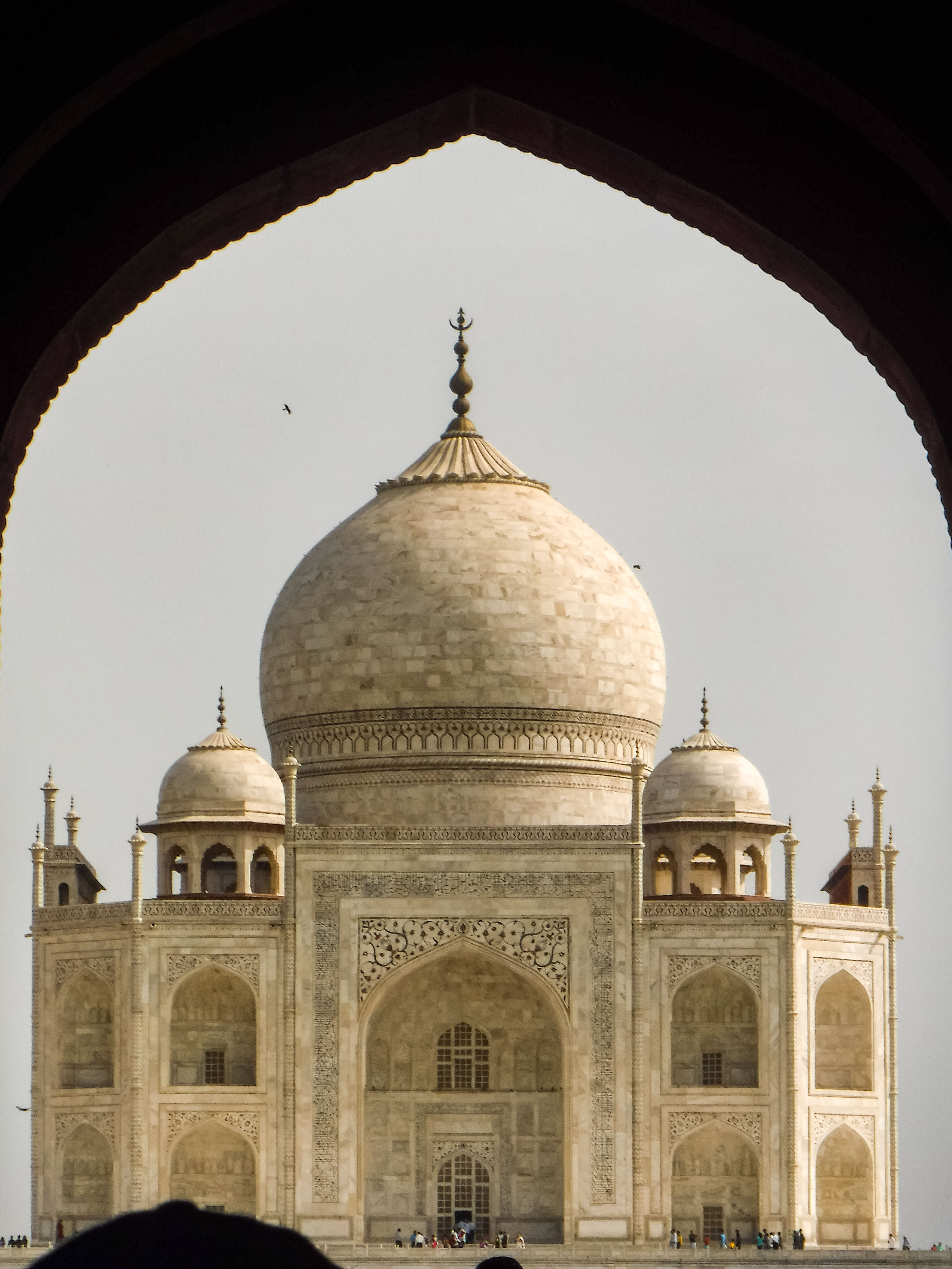
The Taj Mahal is one of the great wonders of the modern world and although I’m not normally given to romantic notions, the thought of visiting this beautiful marble structure brought out the philosopher in me.  I was looking forward to contemplating the vaulted dome and drawing inspiration from the ornate spires that extended up from the walls but unfortunately as is often the case in life, things didn’t quite go as planned.  I managed to survive the turbulent taxi ride through the narrow cobbled streets and despite the lack of pavements and alarming number of cows, dogs and people mingling with the traffic, we didn’t hit anything.  My coping strategy was not particularly brave, I simply shut my eyes until the raucous honking of car horns was replaced by a rhythmic humming of a single car engine.  When I opened my eyes I found we had reached a long empty highway and the taxi driver thought it was his turn to shut his eyes.  I meowed like mad, nipping him on the ear periodically in order to ensure he stayed awake and by the time we reached our destination my nerves were run ragged.

DSCF0404

With renewed enthusiasm, I hopped out of the taxi and made my way towards the huge ivory-white edifice looming before me but an orange man with a loud shirt kept smiling at me, throwing me compliments and trying to make conversation despite my obvious unwillingness to participate.  This smooth operator was an unofficial tour guide trying to sell me his exclusive VIP services and apparently despite his mastery of English, he could not comprehend the word ‘no’.   After scaring me into agreement with his tales of evil pickpockets and ferocious muggings, I let him escort me more as my personal bodyguard than anything else.  Apparently the palace was commissioned in 1631 by Shah Jahan, the fifth Mughal emperor of India, after the death of his wife Mumtaz Mahal during the birth of their 14th child.  It was built on the banks of the Yamuna River and took 22 years and 22,000 labourers to construct.  When Shah Jahan died in 1666, his body was placed in a tomb next to that of his beloved Persian princess.

As I wandered around the palace and its surrounding buildings, I admired the way the walls and ceilings were decorated with artistic calligraphy, elaborate geometric forms and detailed depictions of flowers and vines carved into the stone inlays.  Bizarrely, there was a distinct lack of signposts or information boards throughout the complex which proved to be a potential problem when I realised that my tour guide had abandoned me.  Thankfully my superb sense of smell enabled me to navigate my way through the crowds of tourists as I trotted towards the exit.  I should add that despite my remaining on full alert for pickpockets, it appears the only crook on site was that dodgy tour guide.  I waved goodbye to the police officers guarding the outskirts of the palace and spotted my crazy cab driver with a friendly smile on his face and a bowl of water in his hand.  I gave him an appreciative purr and gulped the fresh water hoping it would give me courage for the wild ride back to my digs.

Shad’s big adventure (part 2)

My feline friends were shocked when I told them that I wanted to visit Wildlife SOS because it’s in India, a long way from home and a surprising turn of events for a cat who enjoys his home comforts and prefers not to overexert himself unduly.  But the allure of the rescued pachyderms was proving hard to resist and I was curious about their natures and the lives they now lead.  John took the most convincing as he was obviously worried (although at the time I didn’t understand why) but he eventually agreed and was delighted that I was about to embark on my first big adventure.  The preparations were a gargantuan task – insurance, visa, tickets, travel arrangements, safety issues, health implications, access to food and water, car drivers, vaccinations, communication with home, etc.  But after months of planning, I set off with my backpack ready to experience everything that my quest had to offer.

I asked a few people to take some snaps of me on the way and you can see me snoozing with my blanket on the plane and chatting with the air stewardesses in these photographs.   My driver met me at the airport and as I started the 4 hour ride to my first stop, I understood John’s concerns.  The roads were chaotic with cars driving in every direction, missing each other by a whisker and honking their horns incessantly while cows and stray dogs wove their dangerous way through the traffic and motorbikes zoomed past carrying 3 or 4 people at a time with no helmets and babies in tow.  Piles of rubble and litter lined the streets while swarms of people went about their daily business in the stifling heat.

My first night in India was spent at a hotel in Rajasthan so that I could visit Ranthambore National Park the next day, an area designated as a protected habitat for a range of the country’s indigenous wildlife from palm squirrels to porcupines, pythons to hyenas.  The jeep arrived the next morning for the tour and I hopped on to the front seat as the rear row was occupied.  To my horror the seat belt didn’t work and I was not prepared to risk life and limb so a gentleman in the back agreed to swap places with me.  This turned out to be a wise move as the jeep drove like the clappers all the way to the entrance of the park.   At this point the jeep slowed down just enough for me to take in the bleak terrain, an eerie mix of barren sandy earth speckled with bunches of dry yellow grass and dead-looking saplings.  Here and there, a water hole was hidden in the desolate landscape and even a lake shimmered quietly surrounded by lush green trees which were lucky enough to find a means of quenching their thirst.  Animals gathered at the ponds including spotted dear, blue bull antelope, peacocks, monitor lizards and a myriad of smaller birds like bright green parakeets, little black and white wagtails, crows, sparrows and finches.

The highlight of the tour was the fantastic sighting of a beautiful tigress wandering through the dry grasslands marking her territory by spraying on nearby vegetation.  Unfortunately the sighting caused a frenzy of activity when the jeeps in the area all converged towards this amazing animal but thankfully she took it in her stride, looking over her shoulder from time to time without showing any signs of obvious stress.  I gazed in awe at this magnificent member of my species and the jeeps followed her at a reasonable distance until she sauntered off into the forest.  She was truly stunning, lean, untamed and radiant, and I wished there were more of them but sadly they are dramatically decreasing in numbers thanks largely to poaching to meet the demands of humans who believe in the medieval principles that form the basis of Chinese medicine.  So there I was, lost in the wonder of the moment, contemplating the splendour and complexity of the world’s ecosystem, when the jeeps suddenly  revved up their engines and began hurtling away at breakneck speed.  Bumping and skidding across the rubble on the paths, my bottom left the seat on several occasions and I gripped on to the side bar as though my life depended on it.  Dust flew up from the tyres and the jeeps one behind another like a giant snake tore towards the exit.  Apparently they were in a hurry because they were late and had to be out of the park by 7pm so that the tigers could enjoy some peace and quiet, the drivers are heavily fined if they fail to leave on time.  It was a fur-raising ride but we made it to the borders of the park with seconds to spare and I breathed a sigh of relief until I saw how much dirt was on my coat and realised I’d have to spend the next 2 hours licking it all off.

Unfortunately Video very jumpy difficult to it still in these jeeps

Shad’s big adventure (part 1)

Its nose is much longer and stronger than mine although mine is better at picking up scent, its ears are much bigger and flappier than mine although mine can swivel, and its tail is much lengthier and bristlier than mine although mine can puff up when I’m startled.  You’d be hard pushed to find any similarities between my furry feline form and the gracious grey bulk of an elephant, but my fascination with these gentle giants from the elephantidae family go back a long way.  It could be the delicate balance of strength and gentility that intrigues me, or the emotional intelligence and supportive social activities of the herd that is so beguiling.  To satisfy my elephant infatuation, I watch nature documentaries on the television with John and I follow the stories of the Asian elephants rescued by the animal welfare charity Wildlife SOS in India.

DSCF0331-Edit

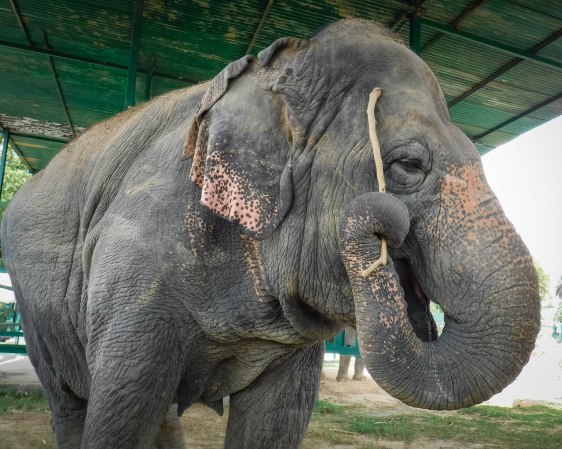
Most recently the story of Rhea, a 53 year old circus elephant kept chained to one concrete spot unless she was performing unnatural tricks for her ignorant audience.  Rhea lived with 2 other elephants called Mia and Sita for decades and would have formed strong emotional bonds with these elephants while they were trapped together in those miserable conditions.  Mia and Sita were rescued in November last year by Wildlife SOS and taken to their Elephant Care and Conservation Centre in Mathura near New Delhi but due to legal complications, Rhea was left behind.  Alone for 5 months without her best friends she must have doubted she would ever see them again but Wildlife SOS worked tirelessly and never forgot the promise they made to her to return and secure her freedom.  Finally in April the elephant ambulance made the 350km trip back to Tamil Nadu to rescue Rhea and reunite her with her companions.  I remember watching the video of that magical moment when she saw her ‘sisters’ again, their heads came slowly together and their trunks intertwined, eyes twinkling with delight.  The 3 elephants in these pictures are Mia, Sita and Rhea and they enjoy spending every moment of their days together as they recover from their years of sorrow and pain, deprived of food and water and beaten into submission.  Now they have shade and sand, food and veterinary care, and their own private paddling pool.

Most of the elephants at the Wildlife SOS Elephant Care Centre are taken for long walks every day by their keepers where they can be free to explore their surroundings and experience soft earth under their feet often for the first time in years.  Unfortunately most of the elephants have painful foot conditions that require daily treatment because of the abnormal lives they endured before.  Rhea would have spent years on her feet never being allowed to lay down which might be why I love to look at the picture of her laying by her sand pile with her 2 friends Mia and Sita beside her, able to relax and take a snooze for the first time in decades.  She snores by the way!

Looking after the elephants is hard work – preparing 25 kg of fruit and 100 kg of fodder per elephant per day takes an awful lot of chopping, bundling and carting around.  The keepers also hoist bunches of fodder up to the rafters to mimic the trees and the elephants love to stretch their trunks high to grab the juiciest bits.  Phoolkali puts the huge reeds of grass into her mouth with her trunk and strips the leaves off which she chews happily while she discards the tough stem.  She also enjoys sugar cane treats along with her walking buddy Asha who also loves peanuts.  Talking of peanuts, 6 year old Peanut (seen here with her devoted keeper) is the youngest elephant to be rescued by Wildlife SOS also from a circus, although many of the elephants were liberated from desperate lives as begging elephants or tourist attractions, being ridden by holidaymakers who clearly had no idea of the monstrous treatment an elephant receives in order to become compliant.  Now these magnificent and forgiving animals have a chance to be who they are, to get wet every day and flick sand on their backs and bellies, to chomp on thirst-quenching fruit and snuggle with their friends.

John goes to see the mountain bikers

It’s time to get sporty again with the adrenaline-fuelled mountain bikers as they cycled their equivalent of a double black ski slope at the weekend as part of the Aston Hills black run competition.  Just like ski runs, mountain bike trails are graded according to difficulty from broad flat paths to cross-country single tracks and extreme forest roads.  While most normal people try to avoid obstacles of roots and rocks when they’re taking a stroll through the woods, these mountain bike enthusiasts seek them out.  The sport requires endurance, good balance and core strength and is performed anywhere from a gravel road in the Lake District to a sand dune in the Arizona desert.  It seems the larger and more unavoidable the features, the greater the challenge!

It is for this reason that I decided to stay at home and leave John to the high speed outdoor action.  No lethally positioned jutting out branches or sudden vertical drops for me!  Last time I accompanied John to a mountain bike shoot, I came home with dust between my toes and spikes of sticky pine leaves all over my belly.  Don’t get me wrong, I love the woods and the wonderful trees that provide homes for wildlife and give us clean air and water, but last time I had a tick scare and thought I caught Dutch Elm disease!  After much persuasion from John, I finally accepted that only elm trees can be stricken with this horrible sickness but I have since developed a phobia of fungus which I swear is a result of my experience.  Every now and then I get a flashback it sends shivers down my spine, so my lovely John helps by giving me a vigorous brush down, one of my favourite non-food treats.  Good times!

Shad hangs out with the chimps

These chimpanzees are residents at Whipsnade in Bedfordshire, a zoo and safari park owned by the Zoological Society of London, a charity dedicated to the conservation of wildlife across the planet.  At the beginning of the 20th century there was estimated to be a global population of one to two million chimps.  Sadly there are now fewer than 300,000 living in the wild which is why these chaps are living out the rest of their days in captivity.  Although they will never know the wild where they belong, they are expertly cared for by the staff at the zoo and they play a vital role in educating people about the plight of these little rascals.  The diminishing number of monkeys in the wild is due mainly to habitat loss, human/wildlife conflict and the wildlife trade.  There are some bizarre humans out there who think that keeping a wild animal in their conservatory or a cage in the back yard is a good idea.  So if these primates go extinct in the wild, the animals in this zoo could end up keeping the species alive.

If this bunch of groovy reprobates were to re-populate their species, there might be an extra dollop of crazy in their DNA!  At one point, they were all sitting around quietly hugging and grooming each other when one of the youngsters got bored and darted across the enclosure on all fours like a bucking bronco!  He reminded me of how a cat looks when it does that silly galloping see-saw run at another cat before shooting off in another direction.  So this monkey stops to make sure that someone is looking before he continues to entertain his audience by rolling around on the floor and doing cartwheels.

I was captivated by this little fella whose expressions and behaviour reminded me my little niece and nephew when they come over with my auntie to look after me when John is at work.  It is well documented that chimps and humans share as much as 98% of their DNA which makes chimp DNA closer to a human’s than to a gorilla’s.  The young chimp caught me staring at him and scurried towards his climbing frame so I decided to join in the fun and I ran along the edge of the enclosure in the same direction.  He scrambled to the top of the frame as though he wanted to be higher than me so I scampered back the other way and hid behind John’s camera bag.  The monkey started flicking his head from side to side, ducking it down as though looking for me and making funny exaggerated movements with his lips without making a sound.  I reappeared from behind the bag and the other monkeys started laughing and the little one got all embarrassed and hurried back to the group to hide behind his mum.  Then we saw the keeper arrive with a box of fruit and leaves and we knew it was snack time.  Unfortunately there was nothing for me in the box but I had a sneaking suspicion that John had a few of my special protein biscuits hidden somewhere and I was determined to get my cheeky chops on them!

Shad does the London Marathon 2016

I truly believe that as a member of the felis catus species, I was genetically engineered to always choose the most efficient option and to never expend valuable energy without a beneficial purpose (usually involving food)!  So when I see humans running in the London Marathon for such altruistic purposes as raising money for charity I can’t help but admire their tenacity.  Now don’t judge me for not wanting to run 26 miles for someone else, not everyone has a body that suits lycra.  Although saying that, not everybody in the Marathon wore lycra.  Some brave souls wore far more including an elephant outfit, a rhinoceros costume and an ensemble that resembled a camel, some of my favourite animals who all need lots of support from kind humans because they are either used and abused in the tourist industry for rides or killed for various parts of their anatomy.

Participants did not only run, there were others jogging, walking, competing in wheelchairs and waddling in a Dr Who tardis.  Although the enormous effort put in by the participators is undeniable, let us not forget the many wonderful supporters behind that scenes like those who sponsor to help raise money, those who clean up and those who stand on the side-lines giving out drinks and cheering.  My role I decided was to keep my fur to an acceptably soft standard, curl up on John’s bag and lift my head to nod in approval from time to time as the tired but happy humans crossed the finish line.  Despite the sweat pouring from their faces, there was a lot of sticky moist hugging as people finished the race and stumbled to a halt, looking for their friends and loved ones.  You humans are a special bunch!

Shad does the West Somerset Railway

The gleaming dark green steam engine chugged softly along the platform before its polished black piston rods and driving wheels came to a stop right in front of us.  I looked up to see its driver in his blue overalls covered in smudges of coal smiling down at me on the platform at Bishops Lydeard near Taunton in Somerset.  He told me there would be a wait before departure so John and I decided to take a look around the platform museum before finding a seat on the train.  The museum has on display original relics from bygone years including station name boards, lamps and signalling equipment, as well as black and white pictures depicting scenes of small children being evacuated during World War II and other stories that show how the railway affected people who worked on and used the line.  While John played with the working model railway inside the museum, I wandered through the plethora of bluebells that lined the platform, smelling their sweet scent and adding a little of my own.

As the whistle blew, John came dashing out of the museum and we trotted back to Platform 1 to catch the Kinlet Hall (train number 4936 for all you train enthusiasts).  The Women’s’ Institute had reserved the whole of the first carriage to themselves but we managed to find comfy seats in the next carriage along ready for our journey to Minehead.  “All aboard” bellowed the smartly dressed station master with his long black jacket and shiny golden buttons and the engines hissed in anticipation of take-off.  The hissing got louder and great plumes of steam floated past the window as the train moved slowly forward and the engines began their rhythmic clanger-dee-clack, clanger-dee-clack.  The hissing quietened and the old steam locomotive gradually picked up speed, singing a song that made my John’s face light up – huff puff huff puff, choofa doofa choofa doofa!

The beauty and tranquillity of the countryside around us was a privilege to behold and the fields and valleys of Exmoor’s National Park made me feel glad to be alive. I saw church steeples peeking over the top of lush green trees, beaches of pale sand stretching out to rock pools where whelks, limpets and shore crabs live, and high stems of wheat in cornfields that must have hidden a wealth of wildlife like badgers, dormice, moles hedgehogs.  We arrived at our destination of Minehead a quintessentially English seaside town, and took a stroll along the coastline enjoying the fresh sea air of the Bristol Channel.  On our return trip to Bishops Lydeard I chuckled at the delightfull quirky names of some of the stations we stopped at along the way like Williton, Watchet and Stogumber.  The whole experience was wonderfully nostalgic and by the time the train came to a complete halt, I had drifted off into one of my daydreams.  This time I was dressed in a smart black jacket with golden buttons with my very own whistle helping the station master issue tickets and make tea for the engineers!

Worthing ….Wind and Kite Surfing Photos

Hi all John here; Shad has let me loose on his blog page. As most of you know I regularly visit Goring Gap and the Sea Lane cafe to take pictures of the Kite and Wind Surfers.

Several of you have approached me about the pics I take and where they can be found.

Instagram

Flickr

Shadow Photography

If you find yourself on any of my pages please feel free to contact me and I will forward a copy of the picture. If you would like a print then go over to my website where I use Loxely Colour for all my printing.