Shad meets the Race Horses

The early morning spring light was veiled by the heavy mist that lingered across the green gallops forming the backdrop for a location photography shoot John and I attended a few days ago.  Regular readers will know how much I love being in the countryside spending time with nature, so you can imagine how excited I was to get up close and personal with some of the fastest and highest prized horses in the world.  We were attending a course that took place in Newmarket (apparently the ‘headquarters’ of horse racing) with dinner and an overnight hotel stay included.


The food was delicious and the other photographers were friendly, although there’s always one who thinks he knows it all and kept flashing his equipment at the table.  I managed to exchange a couple of surreptitious eyebrow raises with the silver-haired guy opposite me and remembered an old Chinese proverb which, in my words, goes something like this – “he who brags loudest, shoots daftest”!  I noticed a man with thinning light brown hair and a quiff look sternly at me.  Apparently he didn’t think a cat should be at the dinner table.  But I soon impressed him with my impeccable manners, being sure not to slouch, put my paws on the table or lick anything below the waist!


Now I do like my peace and quiet at night and that’s exactly what I got when I went to sleep on a soft pillow at the bottom of the bed John slept in.  I woke to the joyful sound of birdsong while it was still dark.  I do like the birds and being a domesticated and sophisticated feline photographer, my instincts to chase them are well controlled thanks to my keen cognitive abilities, pursuit of photography and John’s exemplary care (he makes sure I have plenty of games to keep my mind occupied).  When we went down to breakfast, the staff remembered me from the night before and gave me some extra salmon and scrambled eggs to keep my fur silky and prepare me for the busy day ahead.


Nothing had prepared me for strolling across the gallops just after dawn with hundreds of racehorses gathering around to do their morning workouts.  They were so tall and muscular, their short shining coats glistening with sweat and hot air blasting out of their nostrils as they snorted and whinnied their way past me.  I must admit I was slightly nervous when one of them stopped directly in front of me and lowered his head, but he gently pushed his big soft nose against my cheek as though he knew I needed some encouragement and from that moment on, I was well away!


He introduced me to the stable cat – a striped tabby boy who sat proudly on the ground watching the riders and trainers head out with the horses while the staff and grooms stayed behind to work in the yard.  And did they work!  Heavy wheelbarrows and water buckets were used to clear up the copious amounts of dust, dirt and manure that get caught in the most unattractive of places.  The bedding is changed in the barns every day, the tack must be cleaned down and the horses feet must be picked to remove all the muck I presume.  Apparently I’m not the only animal that needs to clean the toe jam from between my tootsies.  But unlike some animals, I don’t do it in public!  After a day at the stables I didn’t exactly smell delicious, so I packed up early to begin my washing routine and let John mingle with the rest of the photographers, smiling at the ladies and admiring the gee-gees

Shad takes his first trip on a train

John likes the smell of burning coals, I prefer the aroma of ‘Just Tuna Flakes in Sauce’, but everyone’s different!  The smell of burning coals was not the only odour to waft up my nostrils during my second visit to the Bluebell Railway.  My tail stood erect with the tip bent over in greeting as I trotted importantly past the friendly Station Master and twitched my nose as I picked up the scent of bacon and eggs from the restaurant, the flowers that lined the banks of the station, and the whiff of polish being used to buff the brass components of the steam engines sitting in the engine shed.

I hopped on to a bench and basked in the warm sunshine, watching John jostle with the other photographers and steam engine fanatics to get some good shots of the rolling stock.  Every time a steam engine blew its whistle, they would all dash over to it like a herd of gazelles, trying to find the best position.  Suddenly one of the guards announced that the 11am train to East Grinstead was about to arrive and crowds of happy faces gathered at the edge of the platform, eager to step on to the vintage vessel and take a trip across the countryside and back in time.

This particular train was built in 1925 and made it through the Second World War to be lovingly restored and maintained by the good folks whose passion for steam engines motivates them to spend many hours of their spare time working at the station in various capacities.  John scooped me up and put me in my basket so that I was safe and we settled into a third class carriage with a compartment all to ourselves.  There were no electronic doors or security cameras, it was authentic and old-fashioned inside, complete with highly polished wood and brass, pre-war advertising slogans and rusty metal signs in old money.

As the locomotive chuffed along the tracks, I gazed intently through the window at the woodland and fields of grass, desperate to catch a glimpse of some native British wildlife.  Suddenly John pointed through the glass at some deer grazing serenely in a pasture and I was pleased to see a few other forms of life including horses, birds, sheep, cows and bunnies.  The most commonly occurring forms of life were the train-spotters with cameras lurking in all sorts of weird and wonderful places off the beaten track!  It took around 45 minutes to get from Sheffield Park Station to East Grinstead where we stretched our legs before hopping back on for the return trip.  It was a fabulous experience, chugging along through the countryside, a gentle breeze flowing through the compartment.  There was a distinct sense a community about the workers at the station who had a love of steam engines in common and the passengers who shared an appreciation for nature and the simpler things in life.


https://shadthecat.wordpress.com/shad-goes-to-the-bluebell-railway/

Shad does the Shoreham RNLI lifeboat station

It was an incredibly bright day with almost no clouds in the atmosphere, and the sky and sea were virtually the same shade of pale blue.  The water glistened delicately in the sunlight which reflected off the features of the environment down at Shoreham Harbour.  These are great conditions if you want to sunbathe, but no so great if you want to take photographs because the camera does not differentiate well between the various structures in the landscape.  So John and I spent some time wandering around the grassy bank at the mouth of the River Adur, listening to the sound of children playing in the remains of a fort built over 150 years ago to defend the old trading port.  There was a long jetty for fishing and flint stone walls strengthened the coastline.  We watched the sail boats cruising gracefully out to sea and spotted an RNLI lifeboat station.

The doors were open and the bright orange boat was proudly displayed on the slipways, ready for action.  It’s a new Tamar all-weather lifeboat with a top speed of 25 knots enabling the crew to reach its casualty quickly and has shock absorbing seats to help the crew be more comfortable (if that’s possible on a choppy sea in a search and rescue mission).  The local community raised the funds necessary to knock down the old lifeboat station which was inadequate and prone to flooding and replace it with a modern facility that opened in 2010.  The boat is named Enid, after the lady whose generous legacy funded a large portion of its £2.7million purchase price.

We also took a trip to the airfield and a stroll along the river.  The airfield was busy that day and we spotted a few choppers and plenty of light aircraft with three-bladed propellers and the odd bi-plane.  The tide was out so the river was not at its prettiest, with mostly mudflats and silt on view which looked like brown sludge.  There were lots of pools of water where the seagulls gathered to bathe, ruffling their feathers and flapping around, making a right old song and dance of it.  I flicked my tail at them disdain and trotted back to the car.  John had a hankering for an ice-cream and I quite fancied a lick of it so we set off on our next mission to find an ice-cream van.

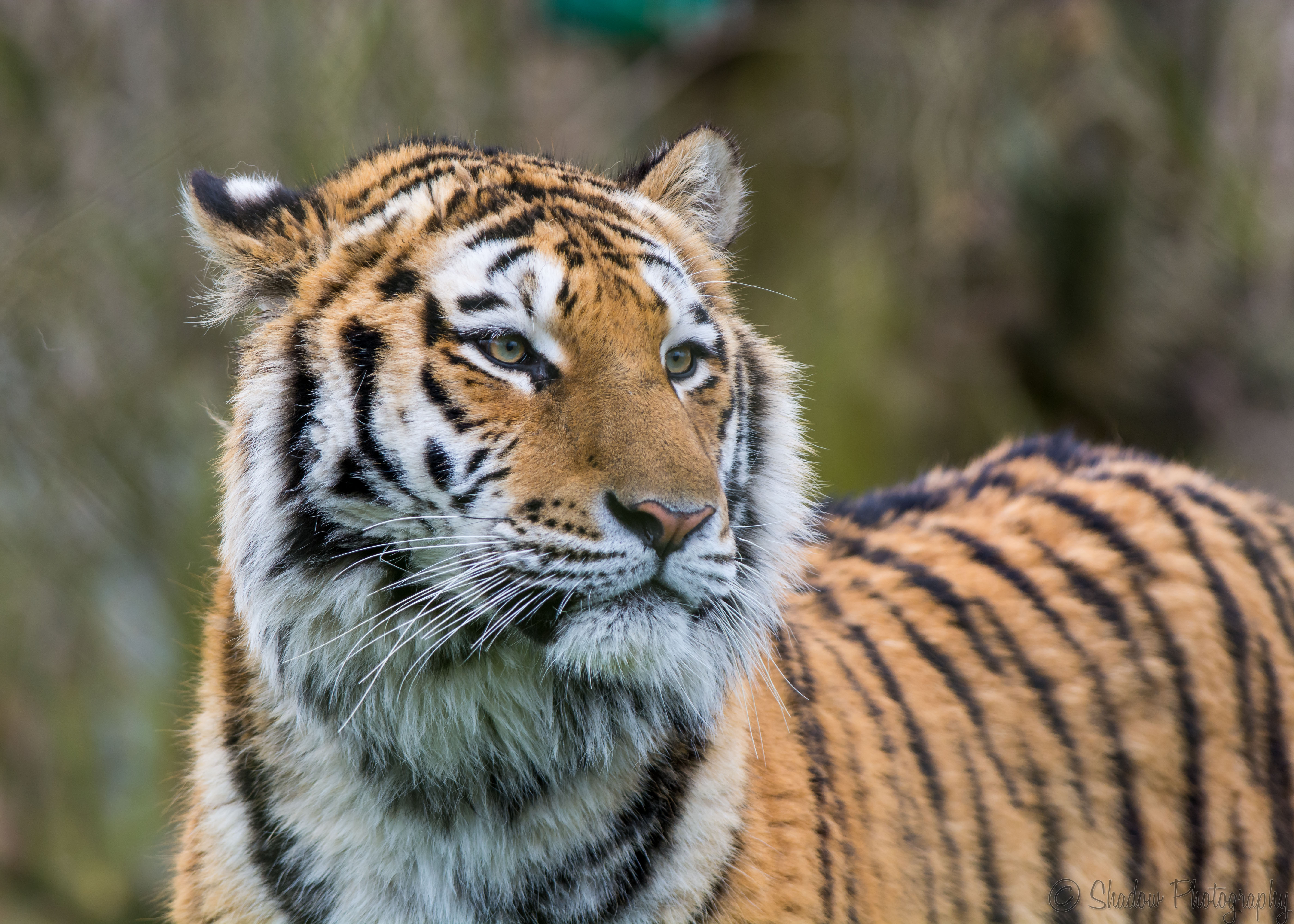
Shad admires the Amur

This beautiful guy is called Bagai (affectionately known by us photographers as Baggie) and resides at Marwell Wildlife Park.  He is around 18 months old and the keepers are hoping he will eventually breed with his wife-to-be Milla, after they are introduced to each other later this year.  He is an Amur tiger (also known as Siberian tiger) and is characterised by his bold rusty-yellow colour with narrow black/brown stripes, short legs and long tail, and supple muscular body.

Bagai

I have a strong affinity for my big-cat kin, particularly the tigers, because of their ongoing crusade to survive against the odds.  There are now more Amur tigers in captivity than there are in the wild due to two main threats – poaching and habitat destruction. They are poached mainly to satisfy the demand for traditional oriental medicinal products made out of parts of the tiger.  Some gruesome examples include crushed tiger bone added to wine as a tonic and eyeballs rolled into pills as a cure for convulsions.  Revolting and totally without scientific basis.  Habitat destruction is often the result of increased demand for land as the human population grows, as well as intensified logging and agriculture for economic reasons. Habitat destruction in their natural environments of the Russian Far East, China and the Korean peninsula has not only removed the vegetation itself, which affects the soil and water balance, but also removed a significant portion of the tigers’ prey species, making them hungry and less inclined to breed.  Other threats include urban expansion, road construction, mining, fires and inadequate law enforcement.

There are nine recognised subspecies of tiger. Of these, the Caspian, Bali and Javan tigers are extinct and the South China tiger has not been sighted in the wild for over 25 years. The Indian or Bengal tiger is the most numerous but it is estimated that the total population is under 2,500 individuals.  In the 1940s, the Amur tiger was on the brink of extinction, with no more than 40 individuals remaining in the wild.  But thanks to vigorous anti-poaching and other conservation efforts in Russia with support from organisations such as the World Wildlife Fund, the population has recovered in the last decade and currently remains at around 400 individuals.  It is predicted that there will be none left in the wild within the next decade if human-kind does not take drastic action to save them.


But fear not my friends, it is not all bad news.  Big cats are prolific breeders and, given enough space, prey and protection, tigers can recover and re-claim their status as lord of the jungle. If you want to help, check out the WWF website for some ideas, such as sending an encouraging postcard to the rangers, the unsung heroes who work under harsh conditions on the frontlines to keep vulnerable wild tigers safe.  One thing all humans can do is ensure that any items they buy do not contain wild animal parts or lead to the unethical treatment of wild animals. Check that your paper and wood products are certified, that food products use certified sustainable palm oil and that your coffee was grown in harmony with its environment.

Shad talks about snowy owls

The snowy owl is one of the most recognisable of owls due to its cat-like yellow eyes and unmistakeable white plumage that echoes its Arctic roots.  It’s the largest (by weight) North American owl and is a carnivore, living up to 10 years in the wild and weighing around 3 to 7 lbs (up to 3kg), with a wingspan of 4 or 5 feet (up to 1.5m).  This regal creature is diurnal which means that it is active both day and night, unlike most owls that tend to hunt solely at night.  The snowy owl is a patient hunter with keen eyesight and extraordinary hearing which enable it to identify prey under thick vegetation or snow-cover, before swooping down to deftly seize its quarry with its sharp talons.  The snowy owl’s preferred meal is lemmings (a fierce little rodent smaller than a chipmunk), consuming 3 to 5 each day, and supplementing its diet with rabbits, rodents, birds and fish.

These magnificent owls sometimes remain year-round in their northern breeding grounds, but they are frequent migrants to Canada, the northern United States, Europe, and Asia.  Unless you’re planning to visit the high arctic, you’ll mainly find them in the wild during winter in windswept fields or wide-open areas such as dunes or shorelines, perhaps around Canada or Alaska.  They like tree-less places and rolling terrain where they can find a vantage point to survey the surrounding area, seeking out a good view by perching on telephone poles, buildings, hay-bales, or fence-posts.  In summer, the snowy owl hunts lemmings and other prey in the 24-hour daylight of the Arctic Circle.  Snowy owls were known to breed on the remote islands of the Shetland Isles north of Scotland in the past, but their status in Britain is now that of a rare winter visitor to the Shetland and Outer Hebrides region.

The snowy owl’s beautiful white plumage helps it to hide in its Arctic habitat. They breed on the Arctic tundra, where females lay a clutch of 3 to 11 eggs, depending on the availability of food, and in particularly lean times they may not breed at all. Parents are territorial and brave and will defend their nests against all threats, including wolves and humans.  Only the males are completely white, often flecked with dark brown when they are chicks, they get whiter as they get older.  The females are usually darker than males or may be white with dusky spots on their wings.

I don’t think John will mind me saying that he has the entire collection of Harry Potter movies (for his grandchildren to enjoy so he claims) and I have watched them through on several occasions.  Harry’s owl Hedwig is a snowy owl and although the character is a female, she is played by male owls because their plumage is so white and they are lighter than the females and therefore easier to handle for the human actors.  Seven different owls apparently played the role of Hedwig and their names are Oops, Swoops, Oh Oh, Kasper, Gizmo, Elmo and Bandit.

Shad snaps the smooth swift surfers

The recent wet and windy weather has sadly wreaked havoc for many people across the country.  I can’t imagine what it must feel like to see your home flooded with water and lose your most treasured possessions, like those photos and trinkets that have sentimental value and are irreplaceable.  John and I have been quite fortunate and although there has been some localised flooding and roads blocked, we have not had evacuations, power loss or injuries in the area.  But like many things in life, there are two sides to every story, and we witnessed the fun side of the unsettled weather the other day when we stopped on the sea-front to watch the guys and gals I their wetsuits riding the waves.  They looked so happy out there, pushing their bodies to the limit to harness nature’s powers just for the challenge of it, smiling and waving to us while the strong winds drove salty rain-drops into their faces.

Suddenly I picked up a powerful smell in the air and turned to see a pretty blonde canine whose enthusiasm for the outdoors bordered on bonkers!  Despite the pungent smell of wet dog (bet you thought I was getting a whiff of something else!), I chuckled to myself as I watched her bounding across the damp sand and shingle to the water’s edge to fetch a stick and go running happily back to her master for another go.  Dogs seem to get such a thrill from pleasing their loved ones and demonstrating their loyalty and dependence.  I think it’s important to point out here that cats are devoted too, and depend on humans for care and nourishment, but they show it in their own unique ways.  I like to surprise everyone after dinner with a mad sprint across the house, leaping into the air to land deftly on a piece of fluff in the carpet, hurtling up to John with my ears back, rubbing my cheeks lovingly against his leg, biting his toe, and then diving into my bed in front of the fire for a nice nap with a sweet innocent look on my face!

We got chatting with some of the onlookers watching the surfers, mostly friends and family members who had come to cheer them on.  They told us that the surfers were very serious about their sport and there was friendly rivalry between the kite-surfers and the wind-surfers, but it was all in good taste and part of the merriment.

Shad visits the otters

Otters are one of my favourite kinds of animals because of their happy disposition and kind-hearted attitudes towards each other.  I defy even the grumpiest of humans to watch them and not smile at their playful antics.  They obviously have their duties to perform such as hunting for food, feeding their young, building dens and protecting their environments, but they also engage in lots of fun behaviours just for the sheer enjoyment.

The Asian Short-Clawed otters (the smallest species of otter) were super sociable, chattering constantly to each other and gobbling up their food with gusto.  Apparently they can vocalise 14 different sounds to communicate with each other and they use their feet to find food under the rocks on the river beds where they live in the wild.  We watched the keepers try to replicate this at feeding time by throwing food in places where the otters had to dig using their sensitive webbed feet and those cheeky rascals didn’t miss a single morsel!  They happily chased each other around their enclosure, playing catch with a pebble and juggling a bit of fruit, squawking at the keepers every time they went by.

Different species will vary in their social structure, and the Eurasian otter is a more solitary animal, like rescue otter Millie.  The keepers have tried to introduce her to a companion on a couple of occasions but Millie prefers to be a singleton, making friends with the keepers instead, so she will remain in her safe permanent home at the Park.  The keepers also care for around 15 to 20 rescue otters every year, often orphaned young, using minimal human intervention and clandestine means to ensure their needs are met so that they can be released back into the wild.

The giant otter lives in family groups and is the most vocal of the otters, keeping in contact with its group through continuous barking and squeaking.  Habitat destruction and hunting for their fur are the major causes of their decline.  We watched Simuni and Akuri charging around their enclosure, posing for the cameras and diving into their water with ease and grace.

The North American River otter is the only river otter found north of Mexico and was at the brink of extinction due to its beautiful coat being used in the 1700-1800s in the fur trade which saw the slaughter of hundreds of thousands of these precious animals.  Thanks to the efforts of conservation and wildlife rehabilitation centres, their numbers are slowly increasing.  River otters are mostly active at night which might be why Hudson and Jasper were sleeping in their shelters when we visited.

Shad does the New Forest Wildlife Park again

This weekend was set to have a dry sunny day (an unusual phenomenon given the seemingly endless rain of recent weeks), so John and Natasha decided to give the New Forest Wildlife Park another whirl.  I woke up on Sunday morning to the fragrant aroma of cream cheese and bacon on bagels.  Mmm!  After a quick nibble on somebody’s breakfast, we packed our equipment and the people donned appropriate outdoor-wear before heading west.  Oh and don’t worry, I normally have a healthy protein-based breakfast but Sundays are special treat days and I’m not one to miss an opportunity!

One of my favourite things about the New Forest conservation park is the environment.  Surrounded by trees and shrubs, it feels like you’re deep in the forest and I half expected one of Robin Hood’s merry men to leap out of the bushes in a pair of tights!  Many of the enclosures are open for the animals to roam freely, such as the sika deer, the rabbits and the wallabies.  When I say open, there are still double gates at the end of each section to ensure the animals don’t stray far.  Of course, the open enclosures are only appropriate for certain creatures, not including the pack of 5 wonderful wolves we saw running around their paddock.  We watched them feed and the keeper gave us a talk, telling us all about how the wolves communicate more by body language than by sound, and how much more active they are than cats (the cheek)!  These beautiful creatures were once found in large numbers in this country but hundreds of years of persecution have exterminated them from our lands, a memory than lingers in the instincts of the wolves we saw making a dash for their food before putting a safe distance between themselves and the humans.

There are so many furry mammals there, like the pole-cats, badgers, water voles, ferrets and the elusive pine-martens who were particularly hard to spot.  I also met some of my most impressive and resourceful cousins, the endangered Scottish wildcats (felis silvestris grampia to give them their Latin name).  They resemble muscular domestic tabby cats, but with thicker coats and bushy black-and-brown ringed tails.  They survived human persecution for five hundred years more than the British wolf did, and over a thousand years more than the British lynx.  They are now only found in Scotland and their intelligence, patience and agility are respected by Highland farmers and gamekeepers who recount tales of the wildcat mother dying to protect her kittens from attack or dipping their paws into shallow water to scoop out fish for dinner.  These misunderstood creatures have been portrayed as ferocious but, like most pussy-cats, they enjoy peace, routine, and personal space, and will only attack if they are hunting for food or feeling cornered.

The distinct whiff of dung hit my nostrils and I caught sight of the long shaggy brown coats of the bison wandering around chewing on the grass.  Even bison have been affected by habitat loss and hunting over the years and are now mostly found on ranches or in areas of conservation.  These particular animals are European bison and they are extinct from the wild.  They might grow to 6 feet tall at the shoulder, 10 feet in length and 1,000 to 2,000 pounds in weight, but their pastimes include rutting and wallowing in mud and they stink.

You have no idea how tempted I was to arch my back, raise my hackles and mock charge sideways towards the little harvest mouse chomping on seeds and grains from a bowl in its glass-fronted pen.  But I am a civilised rational feline who can operate a camera and take part in philosophical debate, so I can certainly exercise restraint over my base urges.  With blunt noses, tiny black eyes and hairy ears, harvest mice are the smallest British rodent, around 5 cm long and weighing a tiny 5 to 10 grams.  They have auburn brown fur with a white underside and their scientific name is micromys minutus (how cute is that!).  They seemed very busy, climbing, building their nests and feeding, so we left them to it, and headed off to see the lynx cat.

I sauntered coyly towards the enclosure that contained the lynx, and my eyes narrowed with envy as I caught sight of her elegant tufty ears and thick fluffy ruff that framed her face.  This Eurasian lynx is called Munchkin and she has a stimulating enclosure on a slope filled with trees, wooden climbing frames and sheltered areas.  We gave each other the obligatory eye contact and subtle ear twitches communicated our understanding of each other’s situations.  This solitary and secretive cat allowed us to watch her for a while before bounding up on to one of her ledges in a tree and surveying us from on high.  The Eurasian lynx was an original native of the British Isles but disappeared from Western Europe due to habitat destruction and human persecution.

Next time I’ll tell you about some creatures I met who made me laugh so much.  They live with their families, have whiskers and offspring called pups, and enjoying romping playfully.

The Ferry Home

We arrived at Fishbourne at 3.30pm and took our place in line for the ferry.  The sun was getting low in the sky, making it gloomy and chilly, so I was pleased when the ferry turned up and we rolled on to the ramp for the journey back to Portsmouth.  As the ferry turned around to face the right way, the gulls flew around the boat and the winter sun glistened on the water.  John decided he would go outside to snap a few pictures and I said I’d join him shortly.  But as I sat comfortably in the warm listening to the humming engines and the splashing of the water against the sides of the ferry, my head lolled sideways and my paws dangled over the edge of the soft seat and I was gone, snoring my furry little head off apparently.

When I came to, Natasha was admiring a rather splendid photo John had taken of the sunset.  I gave my face a quick lick to get the sleep from the eyes and looked around.  I could the Solent Sea Forts coming into view, telling me that we were almost there.  The four forts were built on sandbanks and shoals to defend Portsmouth Harbour from attack and also have the advantage of warning ships about the shallow places and sandy elevations that constitute a hazard to navigation.  The sea forts were the last thing I remembered when I woke up at home in my favourite bed next to the radiator, and I went back to sleep to dream that I was romping through the forests with the beautiful jaguars and the lovely tigers.

Geoffroy’s cat

Geoffroy's cat by Stavros043
Geoffroy’s cat, a photo by Stavros043 on Flickr.

It was cloudy and windy but that didn’t stop me from going mad with the camera again at Colchester Zoo with John, Natasha and Jason. Most of the shots were at silly ISO and stupidly slow shutter speeds (photography nerds will know what I’m talking about). The rain came earlier than expected, but Colchester Zoo is 60 – 70% under cover so my fur didn’t get too wet!

I hope you like the picture of this lovely little cat who looks a lot like a domestic cat and is a similar size.  In fact, it is known as the Geoffroy’s cat and is native to the southern and central regions of South America.  Unfortunately its another one that is considered to be at ‘near threatened’ status by the IUCN (International Union for the Conservation of Nature) because of concern over land-use changes in the regions where it lives.