Shad’s big adventure (part 1)

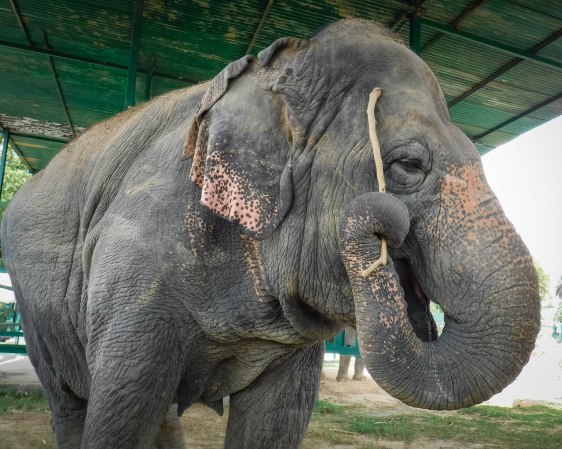
Its nose is much longer and stronger than mine although mine is better at picking up scent, its ears are much bigger and flappier than mine although mine can swivel, and its tail is much lengthier and bristlier than mine although mine can puff up when I’m startled.  You’d be hard pushed to find any similarities between my furry feline form and the gracious grey bulk of an elephant, but my fascination with these gentle giants from the elephantidae family go back a long way.  It could be the delicate balance of strength and gentility that intrigues me, or the emotional intelligence and supportive social activities of the herd that is so beguiling.  To satisfy my elephant infatuation, I watch nature documentaries on the television with John and I follow the stories of the Asian elephants rescued by the animal welfare charity Wildlife SOS in India.
DSCF0331-Edit

Most recently the story of Rhea, a 53 year old circus elephant kept chained to one concrete spot unless she was performing unnatural tricks for her ignorant audience.  Rhea lived with 2 other elephants called Mia and Sita for decades and would have formed strong emotional bonds with these elephants while they were trapped together in those miserable conditions.  Mia and Sita were rescued in November last year by Wildlife SOS and taken to their Elephant Care and Conservation Centre in Mathura near New Delhi but due to legal complications, Rhea was left behind.  Alone for 5 months without her best friends she must have doubted she would ever see them again but Wildlife SOS worked tirelessly and never forgot the promise they made to her to return and secure her freedom.  Finally in April the elephant ambulance made the 350km trip back to Tamil Nadu to rescue Rhea and reunite her with her companions.  I remember watching the video of that magical moment when she saw her ‘sisters’ again, their heads came slowly together and their trunks intertwined, eyes twinkling with delight.  The 3 elephants in these pictures are Mia, Sita and Rhea and they enjoy spending every moment of their days together as they recover from their years of sorrow and pain, deprived of food and water and beaten into submission.  Now they have shade and sand, food and veterinary care, and their own private paddling pool.

Most of the elephants at the Wildlife SOS Elephant Care Centre are taken for long walks every day by their keepers where they can be free to explore their surroundings and experience soft earth under their feet often for the first time in years.  Unfortunately most of the elephants have painful foot conditions that require daily treatment because of the abnormal lives they endured before.  Rhea would have spent years on her feet never being allowed to lay down which might be why I love to look at the picture of her laying by her sand pile with her 2 friends Mia and Sita beside her, able to relax and take a snooze for the first time in decades.  She snores by the way!

Looking after the elephants is hard work – preparing 25 kg of fruit and 100 kg of fodder per elephant per day takes an awful lot of chopping, bundling and carting around.  The keepers also hoist bunches of fodder up to the rafters to mimic the trees and the elephants love to stretch their trunks high to grab the juiciest bits.  Phoolkali puts the huge reeds of grass into her mouth with her trunk and strips the leaves off which she chews happily while she discards the tough stem.  She also enjoys sugar cane treats along with her walking buddy Asha who also loves peanuts.  Talking of peanuts, 6 year old Peanut (seen here with her devoted keeper) is the youngest elephant to be rescued by Wildlife SOS also from a circus, although many of the elephants were liberated from desperate lives as begging elephants or tourist attractions, being ridden by holidaymakers who clearly had no idea of the monstrous treatment an elephant receives in order to become compliant.  Now these magnificent and forgiving animals have a chance to be who they are, to get wet every day and flick sand on their backs and bellies, to chomp on thirst-quenching fruit and snuggle with their friends.

John goes to see the mountain bikers

It’s time to get sporty again with the adrenaline-fuelled mountain bikers as they cycled their equivalent of a double black ski slope at the weekend as part of the Aston Hills black run competition.  Just like ski runs, mountain bike trails are graded according to difficulty from broad flat paths to cross-country single tracks and extreme forest roads.  While most normal people try to avoid obstacles of roots and rocks when they’re taking a stroll through the woods, these mountain bike enthusiasts seek them out.  The sport requires endurance, good balance and core strength and is performed anywhere from a gravel road in the Lake District to a sand dune in the Arizona desert.  It seems the larger and more unavoidable the features, the greater the challenge!

It is for this reason that I decided to stay at home and leave John to the high speed outdoor action.  No lethally positioned jutting out branches or sudden vertical drops for me!  Last time I accompanied John to a mountain bike shoot, I came home with dust between my toes and spikes of sticky pine leaves all over my belly.  Don’t get me wrong, I love the woods and the wonderful trees that provide homes for wildlife and give us clean air and water, but last time I had a tick scare and thought I caught Dutch Elm disease!  After much persuasion from John, I finally accepted that only elm trees can be stricken with this horrible sickness but I have since developed a phobia of fungus which I swear is a result of my experience.  Every now and then I get a flashback it sends shivers down my spine, so my lovely John helps by giving me a vigorous brush down, one of my favourite non-food treats.  Good times!

Shad hangs out with the chimps

These chimpanzees are residents at Whipsnade in Bedfordshire, a zoo and safari park owned by the Zoological Society of London, a charity dedicated to the conservation of wildlife across the planet.  At the beginning of the 20th century there was estimated to be a global population of one to two million chimps.  Sadly there are now fewer than 300,000 living in the wild which is why these chaps are living out the rest of their days in captivity.  Although they will never know the wild where they belong, they are expertly cared for by the staff at the zoo and they play a vital role in educating people about the plight of these little rascals.  The diminishing number of monkeys in the wild is due mainly to habitat loss, human/wildlife conflict and the wildlife trade.  There are some bizarre humans out there who think that keeping a wild animal in their conservatory or a cage in the back yard is a good idea.  So if these primates go extinct in the wild, the animals in this zoo could end up keeping the species alive.

If this bunch of groovy reprobates were to re-populate their species, there might be an extra dollop of crazy in their DNA!  At one point, they were all sitting around quietly hugging and grooming each other when one of the youngsters got bored and darted across the enclosure on all fours like a bucking bronco!  He reminded me of how a cat looks when it does that silly galloping see-saw run at another cat before shooting off in another direction.  So this monkey stops to make sure that someone is looking before he continues to entertain his audience by rolling around on the floor and doing cartwheels.

I was captivated by this little fella whose expressions and behaviour reminded me my little niece and nephew when they come over with my auntie to look after me when John is at work.  It is well documented that chimps and humans share as much as 98% of their DNA which makes chimp DNA closer to a human’s than to a gorilla’s.  The young chimp caught me staring at him and scurried towards his climbing frame so I decided to join in the fun and I ran along the edge of the enclosure in the same direction.  He scrambled to the top of the frame as though he wanted to be higher than me so I scampered back the other way and hid behind John’s camera bag.  The monkey started flicking his head from side to side, ducking it down as though looking for me and making funny exaggerated movements with his lips without making a sound.  I reappeared from behind the bag and the other monkeys started laughing and the little one got all embarrassed and hurried back to the group to hide behind his mum.  Then we saw the keeper arrive with a box of fruit and leaves and we knew it was snack time.  Unfortunately there was nothing for me in the box but I had a sneaking suspicion that John had a few of my special protein biscuits hidden somewhere and I was determined to get my cheeky chops on them!

Shad does the London Marathon 2016

I truly believe that as a member of the felis catus species, I was genetically engineered to always choose the most efficient option and to never expend valuable energy without a beneficial purpose (usually involving food)!  So when I see humans running in the London Marathon for such altruistic purposes as raising money for charity I can’t help but admire their tenacity.  Now don’t judge me for not wanting to run 26 miles for someone else, not everyone has a body that suits lycra.  Although saying that, not everybody in the Marathon wore lycra.  Some brave souls wore far more including an elephant outfit, a rhinoceros costume and an ensemble that resembled a camel, some of my favourite animals who all need lots of support from kind humans because they are either used and abused in the tourist industry for rides or killed for various parts of their anatomy.

Participants did not only run, there were others jogging, walking, competing in wheelchairs and waddling in a Dr Who tardis.  Although the enormous effort put in by the participators is undeniable, let us not forget the many wonderful supporters behind that scenes like those who sponsor to help raise money, those who clean up and those who stand on the side-lines giving out drinks and cheering.  My role I decided was to keep my fur to an acceptably soft standard, curl up on John’s bag and lift my head to nod in approval from time to time as the tired but happy humans crossed the finish line.  Despite the sweat pouring from their faces, there was a lot of sticky moist hugging as people finished the race and stumbled to a halt, looking for their friends and loved ones.  You humans are a special bunch!

Shad does the West Somerset Railway

The gleaming dark green steam engine chugged softly along the platform before its polished black piston rods and driving wheels came to a stop right in front of us.  I looked up to see its driver in his blue overalls covered in smudges of coal smiling down at me on the platform at Bishops Lydeard near Taunton in Somerset.  He told me there would be a wait before departure so John and I decided to take a look around the platform museum before finding a seat on the train.  The museum has on display original relics from bygone years including station name boards, lamps and signalling equipment, as well as black and white pictures depicting scenes of small children being evacuated during World War II and other stories that show how the railway affected people who worked on and used the line.  While John played with the working model railway inside the museum, I wandered through the plethora of bluebells that lined the platform, smelling their sweet scent and adding a little of my own.

As the whistle blew, John came dashing out of the museum and we trotted back to Platform 1 to catch the Kinlet Hall (train number 4936 for all you train enthusiasts).  The Women’s’ Institute had reserved the whole of the first carriage to themselves but we managed to find comfy seats in the next carriage along ready for our journey to Minehead.  “All aboard” bellowed the smartly dressed station master with his long black jacket and shiny golden buttons and the engines hissed in anticipation of take-off.  The hissing got louder and great plumes of steam floated past the window as the train moved slowly forward and the engines began their rhythmic clanger-dee-clack, clanger-dee-clack.  The hissing quietened and the old steam locomotive gradually picked up speed, singing a song that made my John’s face light up – huff puff huff puff, choofa doofa choofa doofa!

The beauty and tranquillity of the countryside around us was a privilege to behold and the fields and valleys of Exmoor’s National Park made me feel glad to be alive. I saw church steeples peeking over the top of lush green trees, beaches of pale sand stretching out to rock pools where whelks, limpets and shore crabs live, and high stems of wheat in cornfields that must have hidden a wealth of wildlife like badgers, dormice, moles hedgehogs.  We arrived at our destination of Minehead a quintessentially English seaside town, and took a stroll along the coastline enjoying the fresh sea air of the Bristol Channel.  On our return trip to Bishops Lydeard I chuckled at the delightfull quirky names of some of the stations we stopped at along the way like Williton, Watchet and Stogumber.  The whole experience was wonderfully nostalgic and by the time the train came to a complete halt, I had drifted off into one of my daydreams.  This time I was dressed in a smart black jacket with golden buttons with my very own whistle helping the station master issue tickets and make tea for the engineers!

Shad Meets the lippizaners

I like horses and I know they like me because I was once kissed by a horse on a fence.  I was on the fence, not the horse, and it was moist and bristly but nonetheless enjoyable.  The beautiful  white lippizan horses you see in these pictures live at the Stanglwirt Riding School in Kitzbuhel, Austria and they did not seem like the type of horse to go around kissing unknown cats on fences.  As John and I arrived by car to the Riding School as part of our Austria weekend, the lippizan horses pranced and skipped in perfect motion from their warm dry stables out on to the snow covered field before them.  I watched their tails swish charmingly from side to side and their manes flow almost magically as they broke into a canter in front of us.

I decided there and then that they weren’t the only ones who could waltz around looking all willowy and elegant.  So when John opened the car door I lifted my nose high into the air and puffed out my chest just as one of the horses looked towards me.  Perfect timing!  With one nimble action I leapt from the seat but unfortunately landed awkwardly on a patch of ice resulting in a minor skid and slight stumble.  Thankfully I recovered my poise quickly at which point I swiftly turned around to hop straight back in the car.  Boy that snow was cold and my knees were wet where I’d hit the deck!

After a marathon licking session my fur was back in place and I was a snug as a bug in a rug, having wrapped myself up in my favourite blanket on the back seat.  I looked through the window and couldn’t help feel a sense of admiration at the stunning lippizaners so impressive with their smooth tresses of hair and muscular frames.   This noble breed is renowned for graceful movements and magnificent physiques, as well as liveliness and good natures.  They are born dark brown, black or grey until the white coat appears between the ages of 6 and 10.  Apparently there are less than 3000 in the whole world so they are highly prized in equine circles.  The horses at the Stanglwirt Riding School were clearly cherished by the humans who cared for them and I could tell by their well-groomed coats, clean hooves and happy temperaments that all their needs were met.  After performing some of their stylish dressage moves, they played in the snow, flicking it around with their powerful legs and chasing after each other.   They reminded me of the lambs I’ve seen frolicking around in the fields at home and I smiled to myself as it occurred to me that I’m not the only dignified animal who likes to fool around for amusement.  I miss teddy!

Check Out more courses from Mark Pain..