Shad does the cricket

Cricket.  John has explained it to me 7 times and I still don’t understand it.  I simply accept that it is what it is – a bat and ball game between 2 teams which involves scoring runs, something about wickets and dismissing a batsman.  While spectators cheer, clap and guffaw in all the right places as they follow play, I adopt a more holistic approach.  As outdoor cricket matches tend to take place in lovely locations, it gives me a chance to ponder the natural world and exercise my imagination while the ball flies across the pitch and into the stumps.  Some of my favourite outdoor deliberations include counting how many seconds a bird can soar along the air currents without flapping its wings, guessing the appearance of the odd-shaped clouds and following those helicopter shaped leaves as they fall from the sycamore trees.

This particular match was Surrey versus Warwickshire and I let John take all the photos while I concentrated on other pursuits such as working my magic on the lovely ladies and gents in the tea tent.  I meowed and gazed lovingly at them with my pupils as dilated as possible which humans always find enchanting.  They gave me a saucer of weak tea and a small piece of a chicken sandwich and I was so grateful that I hopped on the friendly lady’s lap and gave her a big wet kiss on her ear.  She giggled and everybody said how cute I was.  Isn’t that nice?!  With a full belly and a smile on my face, I trotted happily out of the tea tent and found a shady spot close to John for my afternoon nap.  How civilised!

Shad’s big adventure (part 4)

When you go into the woods next time, walk deep into the thicket then stand perfectly still and you might hear the sound of a bird chirping its daily news to a friend in another tree or the snap of a twig trodden on by a deer as it munches through leaves and acorns.  John and I have often wandered through the local woodlands which form part of the South Downs in Sussex and heard the birds sing and the rustle of the wind blowing through the trees.  Standing in the woods many hundreds of years ago we would have heard the grunts and tail slaps of a family of beavers, the barking howls of a pack of wolves or the hissing and chattering of a Eurasian lynx cat.  Sadly due to the intensification of agriculture and human hunting activities many the UK’s indigenous wild mammal populations such as wolves, brown bears, lynx and beavers are now extinct.  This is why I get so excited about the wildlife that still exists in the woods today like the badgers, foxes, otters, rabbits, wood lice, harvest mice, wagtails, buzzards and tawny owls who rely on each other in complex ways and need our protection to survive.
DSCF0389-Edit

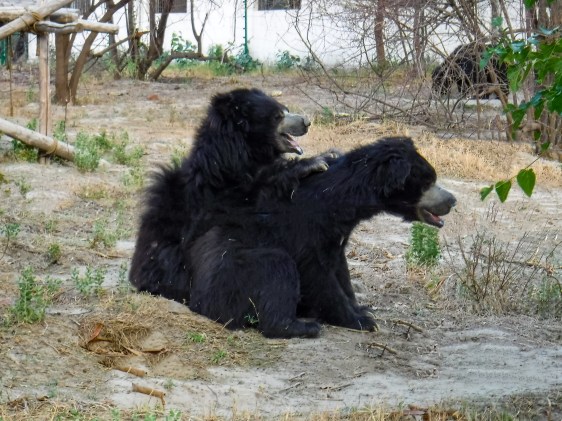
In India the forest surrounding the Agra Bear Rescue Facility managed by Wildlife SOS is alive with squawks, tweets, clicks, growls, wails, screeches and squeaks from the enormous variety of animals that live there.  Their bizarre noises reminded me of those made by tennis players during the Wimbledon finals!   The sloth bears that live at the centre have all been rescued from a nomadic tribe called the Kalandar people who traditionally used them as ‘dancing bears’ for hundreds of years.  This brutal practice involves poaching the cubs from the wild (usually killing the mother), piercing their soft sensitive muzzles with a hot poker and pushing a rope through it which is tugged in order to force them to jump up and down in pain for the entertainment of onlookers.  Hard to believe isn’t it?!

Life at the end of a rope was all these bears knew and many can be seen rocking, pacing and swaying, demonstrating stress behaviours seen in large mammals that have been taken captive and held in poor conditions.  The good news is that Wildlife SOS are doing an excellent job of providing veterinary care to heal their physical wounds and a stimulating natural environment to heal their emotional wounds, and they’ll never have to endure such cruelty again.  To help the bears, Wildlife SOS keepers have installed pools in every enclosure for splashing and general merriment and frames and trees for climbing.  There are also daily enrichment activities such as foraging for their favourite fruits in boxes or feeders and munching on a honey and ant bar.  Nice!

There is plenty of love to go around at Wildlife SOS and all orphaned, abandoned or injured animals are welcomed with open arms, just like the hyena that wandered innocently into a village looking for food and was attacked by the ignorant villagers or the baby deer who lost her mum in a forest fire.  The wild monkeys who live in the trees often steal leftover melons from the sloth bears that are too busy rolling around in the grass to notice, and a blind parakeet that obviously could not survive in the wild lives happily in the office and is taken outside daily for some fresh air.  Wildlife SOS is a sanctuary for many beautiful lives that would otherwise have been lost and their dedication to the environment goes some way towards undoing the damage done by humans who exploit and persecute animals in the name of entertainment, religion or profit.  You can help too by never paying to watch, ride or pet wild animals used in the tourist industry because if you saw the terrible events that occur behind the scenes you would be shocked to the core.

Shad shoots a hockey game

John likes to challenge his photography skills by shooting sports and as he’s the one with the car, the wallet and the opposable thumbs, I tend to follow willingly.  Don’t misunderstand me, I admire the commitment and stamina displayed by the athletes in competitions and I’m glad that they have a means of channelling life’s emotions and frustrations through the performance and community of their sport.  For those of us who lack the motivation or talent for such strenuous activities, dealing with life’s idiosyncrasies is often a more sedate affair.  There are many other options including reading, writing, puzzles, photography and singing.  I frequently sing along with John in the car when he cranks up the Michael Bublé although lately he’s been going through a classic rock phase and I’ve enjoyed the discordant and often thunderous sounds of AC/DC, Van Halen and Metallica.

Despite my affinity for peaceful or solitary pursuits, there are many other cats who engage in sport to varying degrees.  Tigers like to swim, bobcats like to climb and I’ve even seen videos of servals at the Big Cat Rescue Centre in Tampa, Florida unravelling toilet rolls like it was the most fun in the world.  I know I’m stretching the definition of sport just a tad here but if there were organised competitive grooming events I’d be a real contender!   When we domestic cats are kittens we form teams to practice our running and pouncing skills and as we get older, sporting activities generally revolve around stalking our housemates, jumping on anything that wiggles or catching small furry or feathered creatures.  Don’t judge us, it’s in our genes and unlike humans we don’t have a highly developed prefrontal cortex that moderates our ethical and social behaviour.

But back to human sports and these hockey players  not only have highly developed brains that help them make fast decisions on the pitch, they also have highly developed muscles that give them the strength to propel the hockey ball up to 75mph, that’s as fast as a cheetah.  Each team is made up of 11 players and these particular teams were competing in the Hockey Champions Trophy 2016 at the Queen Elizabeth Olympic Park.  The teams use several substitutes throughout the game to keep everyone fresh and energetic and they often wear protective equipment such as gum shields as I imagine a knock from one of those big sticks would sting a bit!  The ones I really admired were the brave goalkeepers who dealt with balls shooting at them, team members yelling at them and opposing players hurtling towards them with grimaces on their faces, hence the leg protectors, chest guard and helmet!